

NLAB, NAB, CCB and TLM panelboards: differences and uses
What sets TLM, NLAB, NAB and CCB panelboards apart: the type of breaker they accept, typical currents and where each one belongs in the installation.
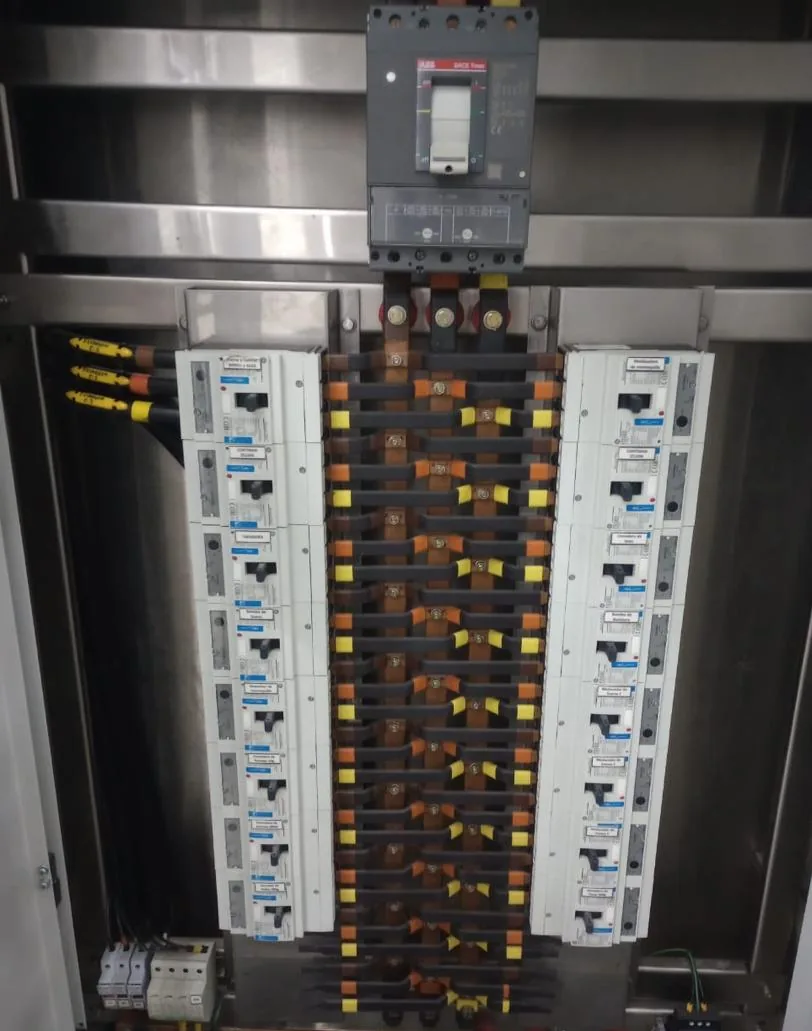
TLM, NLAB, NAB and CCB panelboards differ in the type of breaker they house, the current they handle and the electrical system they are designed for. The TLM is a single-phase residential load center; the NLAB is a lighting and receptacle panelboard for commercial use; the NAB covers commercial and light industrial distribution with higher currents and three-phase configurations; the CCB is a power distribution panelboard that houses molded-case circuit breakers. Choosing the right one depends on the point in the installation where it will operate.
What is a low-voltage switchboard?
A low-voltage switchboard is a metal enclosure with copper or aluminum busbars that receives a feeder and distributes it to several circuits, each protected by a breaker. Its practical classification depends on three things: the type of breaker (plug-in or bolt-on), the current of the main bus and the system (single-phase 120/240 V or three-phase).
TLM: residential load center
The TLM is the typical residential panelboard. It is single-phase 120/240 V, with a bus for 1- and 2-pole THQL plug-in breakers. It is manufactured with or without a main breaker, in surface and flush-mounted versions, and with a number of spaces ranging from small panels with a few circuits to units with 40 or more spaces. The most common main bus ratings for this type of panelboard are in the range of 100 to 200 A.
- Use: apartments, houses, small premises fed at 120/240 V.
- Breakers: THQL 1 and 2 poles (20 – 60 A).
NLAB: lighting and receptacle panelboard
The NLAB is a lighting panelboard of more robust construction than the load center, intended for commercial buildings, offices, schools and clinics. It accepts THQL and THQC plug-in breakers, in single-phase and three-phase configurations, and can be supplied with a main breaker or main lugs. Its typical bus capacity is higher than that of the TLM, and its enclosure accommodates a larger number of circuits and conductors.
- Use: lighting and receptacle circuits in commercial buildings.
- Breakers: THQL and THQC with 1, 2 and 3 poles up to 100 A.
NAB: commercial and light industrial distribution
The NAB follows the same logic as the NLAB, but is specified when higher bus currents, three phases with neutral and the capacity to feed subpanels as well as branch circuits are required. In practice it is the intermediate panelboard between the lighting panel on a floor and the building's distribution switchboard. It accepts 2- and 3-pole THQC breakers and, depending on the configuration, higher-current breakers for the feeders.
- Use: floor or area panelboards in large commercial premises, healthcare facilities, light industry.
- Breakers: THQC up to 100 A; feeders with higher-range breakers according to design.
CCB: power distribution panelboard
The CCB (circuit breaker panelboard) is the power panelboard. Instead of plug-in breakers, it houses bolt-on molded-case circuit breakers: A2A up to 250 A, and XT5N, XT6N and XT7S for 400, 630, 800 and up to 1600 A. Its function is to receive the service entrance or the transformer output and distribute it to the area panelboards, the motor control centers and the large loads.
- Use: main switchboard in buildings, industrial plants, compact substations.
- Breakers: A2A, A2C, A3N, XT5N, XT6N, XT7S molded-case circuit breakers.
Summary comparison
| Type | System | Breaker | Position in the installation |
|---|---|---|---|
| TLM | Single-phase 120/240 V | THQL plug-in | Home, small premises |
| NLAB | Single- or three-phase | THQL / THQC plug-in | Commercial lighting and receptacles |
| NAB | Three-phase with neutral | THQC and feeders | Floor or area panelboard |
| CCB | Three-phase | Bolt-on molded case | Main power switchboard |
How is the right panelboard selected?
- Determine the total current of the feeder reaching the panelboard; that sets the main bus rating.
- Count the outgoing circuits and reserve at least 20 % of the spaces for future expansion.
- Define whether the system is single-phase or three-phase and whether a neutral is required.
- Verify the short-circuit level: the bus and the breakers must withstand it.
- Choose the enclosure protection rating according to the environment (dry indoor, outdoor, corrosive area).
At MARPE we build custom low- and medium-voltage switchboards with ABB and GE product, as well as power houses and compact substations. See our distribution and auxiliary services line for the full scope.
If you have the single-line diagram or the load schedule, send it on WhatsApp and we will indicate which type of panelboard applies and which breakers to equip it with.
QUESTIONS ON THIS TOPIC
What is the difference between a TLM and an NLAB?
The TLM is a single-phase residential load center for THQL breakers. The NLAB is a commercial lighting panelboard of more robust construction that accepts THQL and THQC in single-phase and three-phase configurations.
Which panelboard uses molded-case circuit breakers?
The CCB. It is the power distribution panelboard that houses bolt-on A2A, XT5N, XT6N and XT7S breakers to feed area panelboards and large loads.
Do you build custom switchboards?
Yes. MARPE manufactures low- and medium-voltage switchboards, power houses and compact substations based on the customer's specifications or on a survey carried out on site.
RELATED ARTICLES
GE to ABB breaker cross-reference: replacement guide
Technical guide to replacing a discontinued GE breaker with its ABB equivalent: poles, rated current, kA, voltage, mounting and trip curve, checked one by one.
Read article →
ABB molded-case breakers: A2A series vs XT family (XT5N–XT7S)
When to use an A2A breaker up to 250 A and when to move to the XT family up to 1600 A: TMF, TMA and Ekip trip units, terminals and mounting explained.
Read article →
How to select a thermal-magnetic breaker for your panelboard
Ampere rating, poles, interrupting capacity, trip curve and coordination with the conductor: the five criteria for selecting a breaker on 120/240 V systems.
Read article →